DUERP, MSDs, psychosocial risks: tie risk to real work
A DUERP becomes useful in Réunion when it connects risks to observable situations, production constraints, and the real room people have to maneuver.
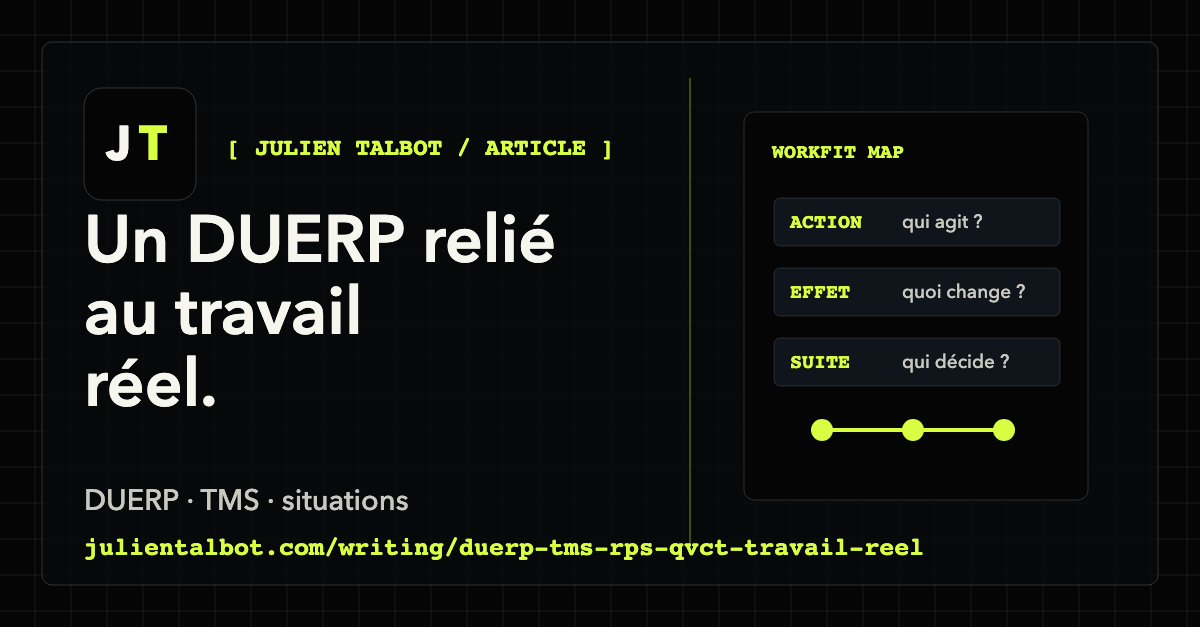
A DUERP can be compliant and still not be very useful. This is common enough: the document exists, risks are listed, families are named, but the organization still does not know what to change first.
The problem is not only documentary. It is a problem of unit of analysis.
When risk is formulated too high up, it becomes hard to discuss. “Mental load,” “repetitive gestures,” “lack of communication,” “stress,” “constraining postures”: these words can be true, but they do not yet say where to act.
Activity ergonomics starts from a different question: in which concrete situations does this risk appear, for whom, at what moment, with which tools, rules, constraints, and possible recovery paths?
MSDs and psychosocial risks often meet inside the activity
MSDs and psychosocial risks are sometimes treated as two separate files. In the field, they often answer each other.
A constraining gesture can be aggravated by pace, lack of help, a recurring breakdown, a quality rule, or customer pressure. A psychosocial tension can come from a poorly designed physical tool, a noisy space, constant interruptions, or the inability to do good work.
That connection matters for the DUERP. If you only see the symptom, you often propose an action that is too short. Gesture-and-posture training can help, but it will not replace an analysis of pace, disruptions, tools, coordination, and room to maneuver.
The right grain: the work situation
A work situation describes what is really at stake:
- the prescribed task;
- time, quality, safety, or relationship constraints;
- available tools and spaces;
- interruptions and disruptions;
- required cooperation;
- the tradeoffs people make to keep the work holding together;
- physical, cognitive, or social consequences.
At that grain, the DUERP becomes discussable. We can ask: what cause is observable? What action would actually change the situation? Who needs to be involved? What could move the problem somewhere else?
What an ergonomic diagnosis produces
A diagnosis does not replace the DUERP. It can make it usable.
Concretely, it can produce:
- a map of exposing situations;
- a reformulation of risks as discussable causes;
- a hierarchy of priorities;
- watch points for managers and leadership;
- action scenarios connected to real work;
- a QVCT support that is more precise than an opinion survey alone.
The goal is not to produce more paper. The goal is to make tradeoffs more defensible.
See the diagnosis.
The weak signal worth taking seriously
The right moment to intervene is not only after an accident or a long absence. It is also when several weak signals line up: short absences, restrictions, diffuse complaints, turnover, tensions between departments, quality drops, the feeling that “everyone is compensating.”
These signals often tell the same story: the organization holds because people absorb constraints that are invisible in the prescribed work.
That is precisely what ergonomics can bring back to the center.