Work diagnosis
Understand what wears work down before prescribing action.
Absenteeism, strain, psychosocial risk, turnover, or transformation: the goal is not another document, but a situation observable enough to decide.
Process
Short, situated, defensible.
The diagnosis reduces ambiguity fast, without defaulting to a long mission.
diagnosis/risk-msd
analysis
❯ Analyze risk assessment — production unit.
Compiling field data...
▸ Absenteeism: +18% vs N-1
▸ MSDs: 5 claims / 6 months
Rank the risks
◆ Identify: time overload peak 2pm-4pm
▸ Cross-check: irregular breaks + pace
Diagnosis: time organization = priority lever
✓ Plan: rework breaks + fine observation
01 Frame
Signal, decision to make, people involved, existing documents, and calendar constraint.
02 Observe
Real situations, rule/activity gaps, recoveries, interruptions, coordination, and shifted costs.
03 Decide
Priorities, usable deliverable, short next step, and follow-up conditions.
diagnosis/risk · 3 axes
Absenteeism: +18% vs N-1
MSDs: 5 claims / 6 months
QWCT score: 52/100 (target >65)
Time overload 2pm-4pm
Irregular breaks + pace
Non-adjustable pallet height
Rework breaks (2-week trial)
Fine observation 2pm-4pm
Adjust height + gesture training
Proof
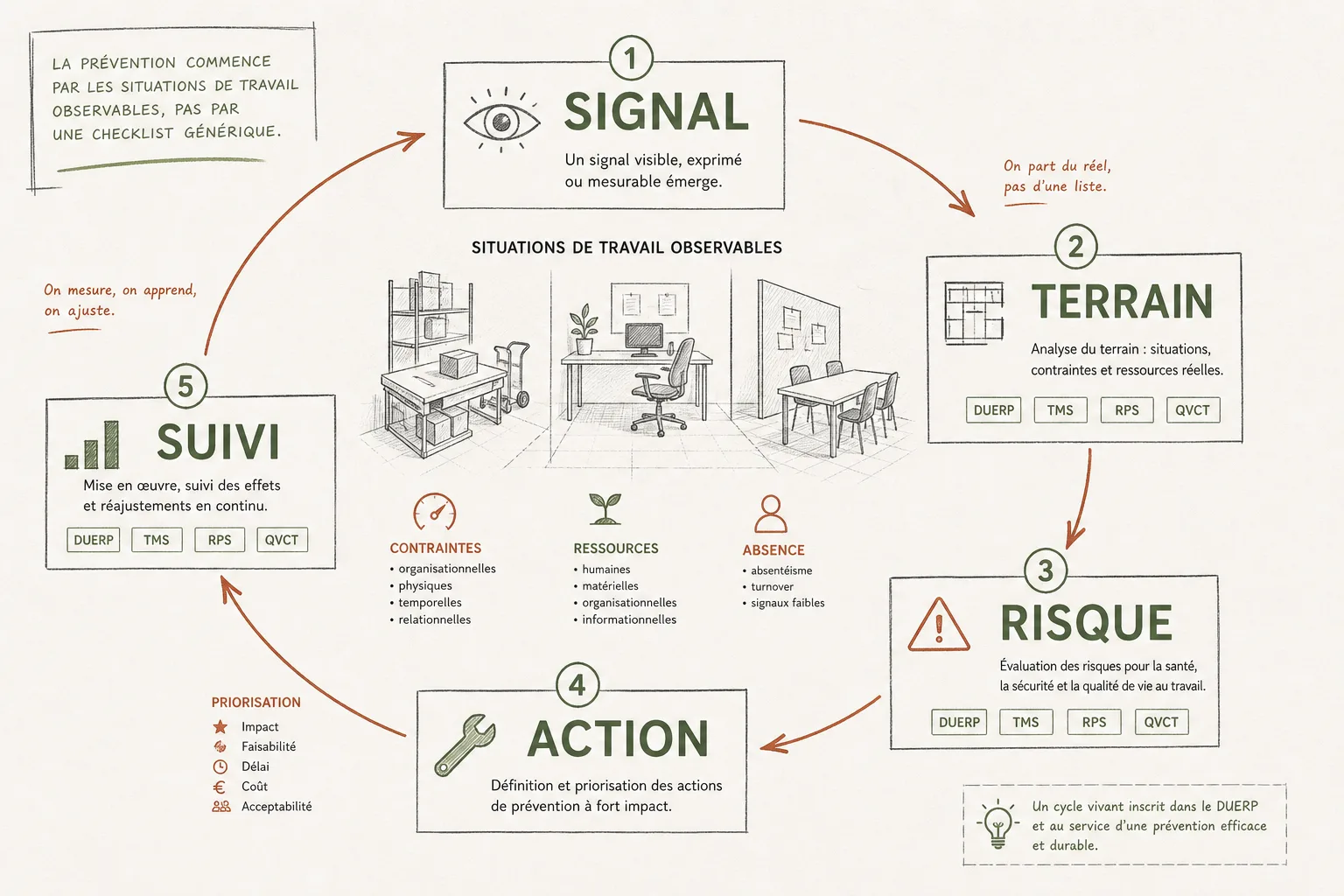
The risk loop, tied to real activity.
The diagnosis does not just name a risk: it ties signal, field, evidence, and decision together so prevention priorities stay debatable and defensible.