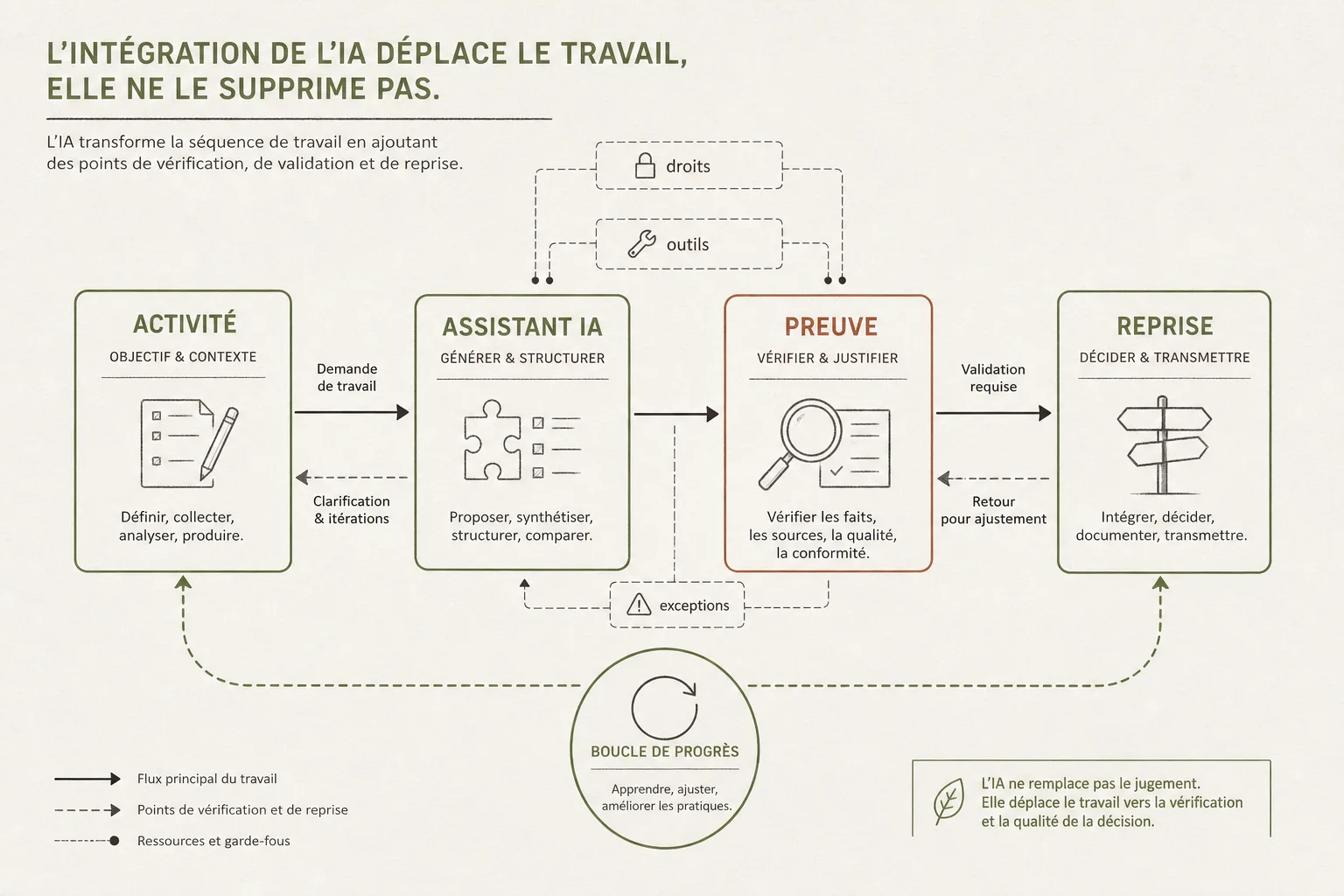
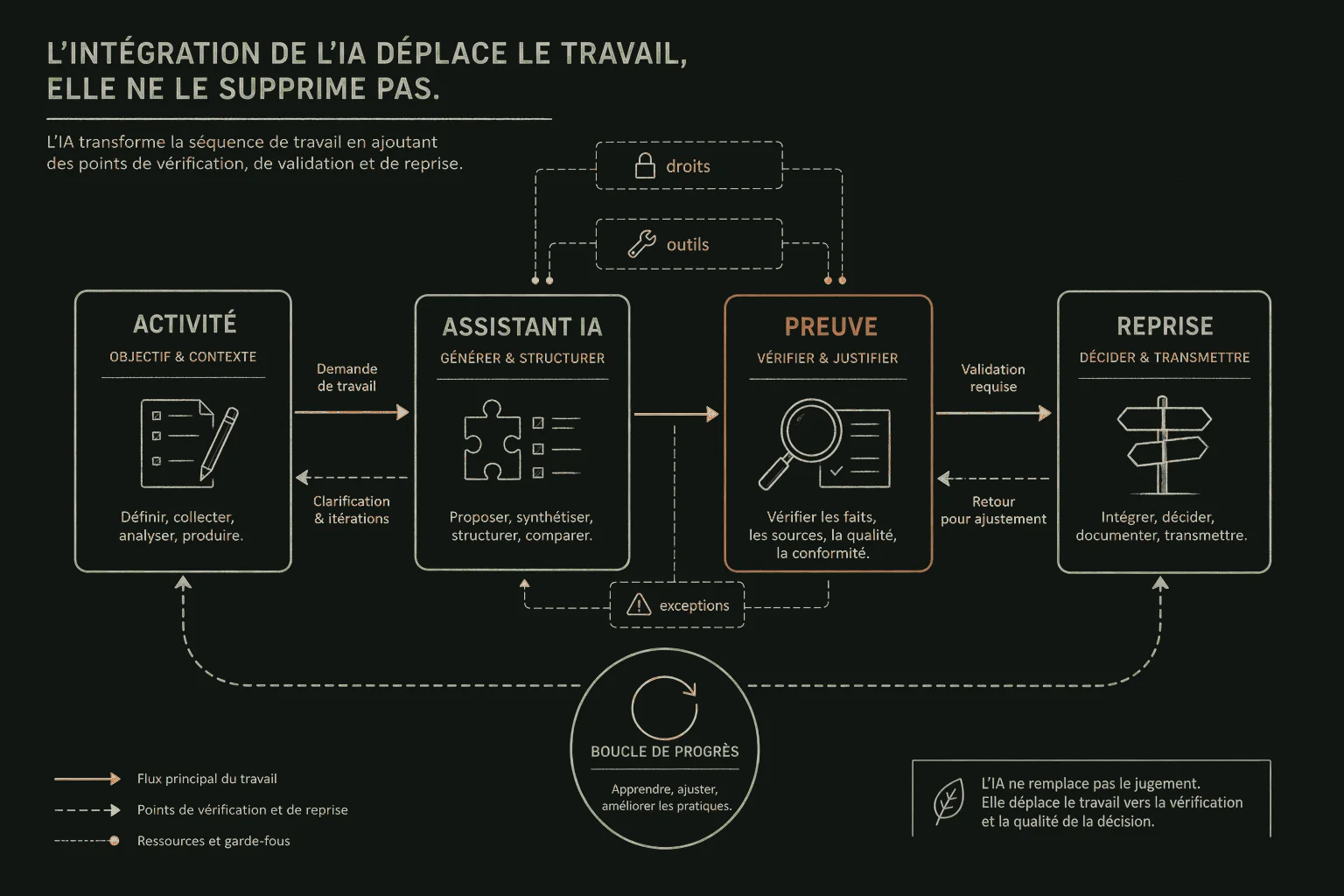
The subject is not only the prompt: it is the transformation of tasks, permissions, responsibilities, and human recovery.
Situated AI
Integrate AI from real work.
AI does not sit cleanly on an organization: it reconfigures tasks, responsibilities, trade-offs, and cooperation. Julien Talbot works with organizations that integrate or supervise agents in real activity.
Direct answer
What Julien brings to situated AI.
Support, HR, operations, compliance, customer relations, document production: anywhere AI touches a case, a decision, or data.
It helps decide what can be delegated, what must remain human, and what traces must exist before scaling.
Situated AI handles organizational integration. Labs handles design, eval, and post-training blockers.
Two paying clients
Integrate agents, or improve the agents being built.
The same field work supports the decision: deploy agents better where they touch real work, without silently shifting responsibility and load.
diagnostic/ai-situated
analysis
❯ Analyze AI usage in the support team.
Scanning field...
▸ Observe 3 workstations, 12 AI exchanges/day
▸ Identify: 2 copy-paste of client data to AI
Map exposure points
◆ Operator interview: "I don't always check anymore"
▸ Identify: human validation bypassed 40% of time
Diagnosis: responsibility shift without framework
◆ Propose: validation gate + 1h training
✓ Diagnosis ready. Decision: frame before deploy.
Organizations using agents
Integrate or supervise agents inside real work.
For framing tasks, permissions, responsibility, human validation, and the work an agent shifts onto people.
Building those agents?
Designing agents is another door: Labs.
If you build agents rather than integrate them into an organization, the field signal is handled in Labs — dedicated.
diagnostic/ai-situated · 3 angles
Observed: 12 AI exchanges/day/operator
Copy-paste of client data: 2/workstation
Human validation bypassed: 40%
Risk: responsibility shift
Operators no longer check systematically
Client data exposed in prompts
Validation gate before send
1h training on sensitive prompts
Supervision: explicit human handoff
Proof
See where AI adds work.
Integration becomes debatable once you see the new points of evidence, validation, exception, and recovery. That is where the right level of autonomy gets decided.