About

Julien Talbot, activity ergonomist.

I work from a simple premise: technology does not matter because of what it promises, but because of what it changes in real activity.

My work makes work situations, responsibilities, trade-offs, and recovery conditions visible enough to design AI systems, tools, and organizational decisions from reality.

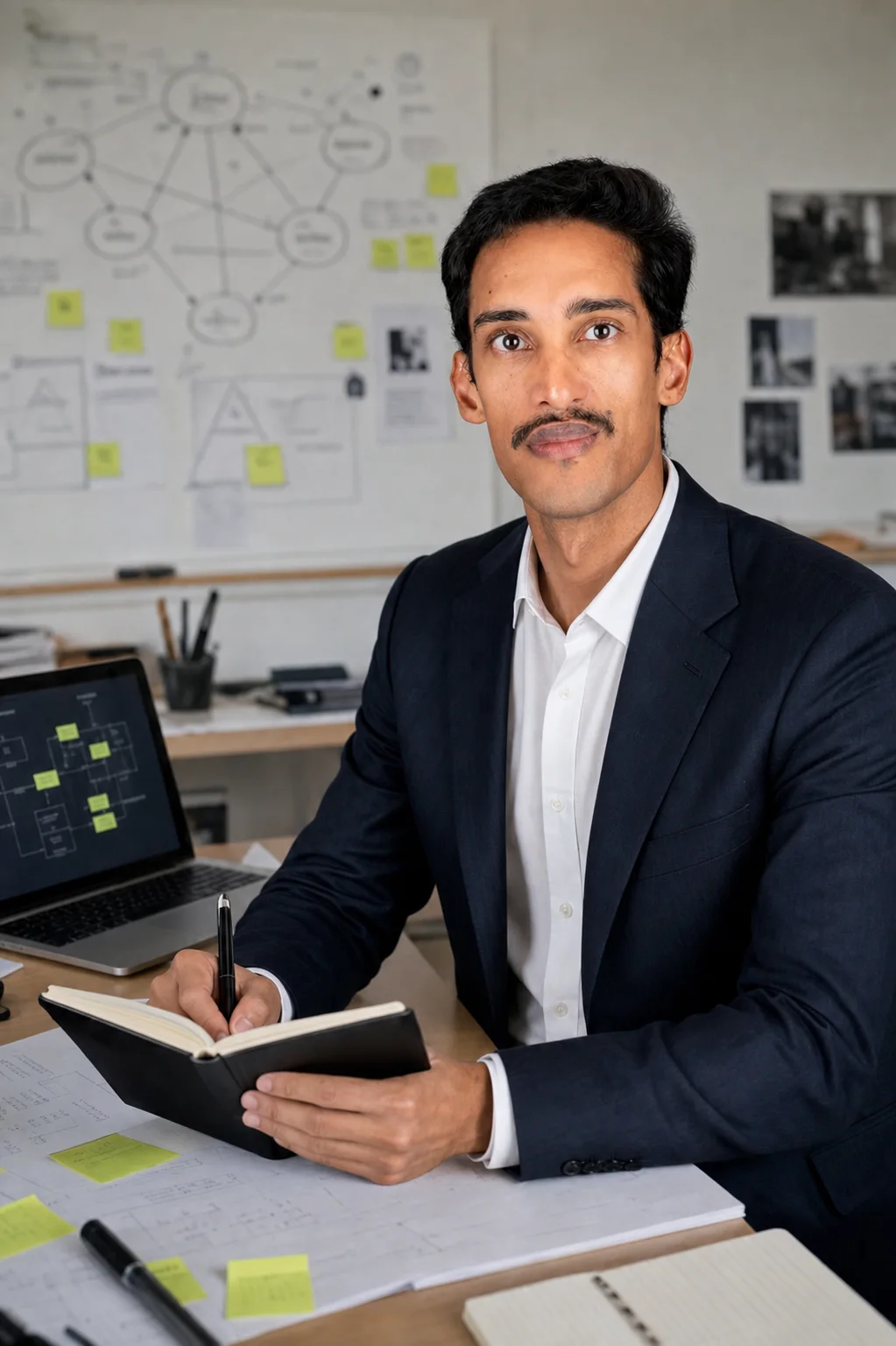
Portrait of Julien Talbot
Activity ergonomics · AI · real work

Organizations, software products, and AI agents all meet at the same point: the activity they make possible, fragile, or invisible.

What I make visible

Observe before transforming.

Activity ergonomics is the method: start from what people, tools, and systems actually do, not from what they are supposed to do.

Real work

What people actually do to maintain quality: trade-offs, interruptions, coordination, local adaptations, and hidden costs.

AI delegation

What a system shifts onto humans: verification, correction, responsibility, supervision, recovery, and trust conditions.

Operational evidence

The traces, stop criteria, recovery paths, and observable states that make a transformation discussable before it scales.

Markers

A few signals, not a resume.

These markers explain why the work connects ergonomics, AI, organizations, and system design.

  • Founder of Ergonomia since 2021.
  • More than 50 organizations supported.
  • AI, Work & Employment lead for CPME Réunion.
  • Teacher in ergonomics and work psychology.
  • Training at Paris 1 Panthéon-Sorbonne, Toulouse Jean-Jaurès, and Sherbrooke.
  • Background in UX, human factors, critical interfaces, and complex systems.
Edited path

A trajectory toward AI in real work.

The full resume exists elsewhere. What matters here is the continuity: interfaces, human factors, activity, organizations, AI, and supervision.

  1. 2017 — 2019

    Human factors, interfaces, and complex systems

    Early work in ergonomics, UX, and interface design, including critical environments such as aeronautics.

  2. 2020 — 2021

    Activity ergonomics

    Focused work on real activity, organizations, cooperation, and situated transformation, including the Paris 1 Panthéon-Sorbonne master program.

  3. Since 2021

    Ergonomia

    Independent practice on work conditions, prevention, digital transformation, and situated AI integration.

  4. Since 2023

    Teaching

    Courses in ergonomics and work psychology, with one thread: learn to observe activity before trying to transform it.

  5. Now

    AI agents, supervision, and real work

    Work with organizations, product teams, and AI labs on delegation loops, observability, verification, and recovery.

Now

I work where a transformation has to become discussable.

Organizations, AI labs, product teams, talks, and teaching are different formats for the same question: what changes in real work, who can verify it, and under what conditions people keep agency?

Start with the work situation

For talks, strategic discussions, or collaboration on AI agents and real work systems, email me directly. If the topic is still fuzzy, the guided request helps shape the useful context.