AI agents in SMEs: start from real work
A useful AI agent does not start with a technical demo. It starts with a situated task, limited rights, verifiable evidence, and a possible human recovery path.
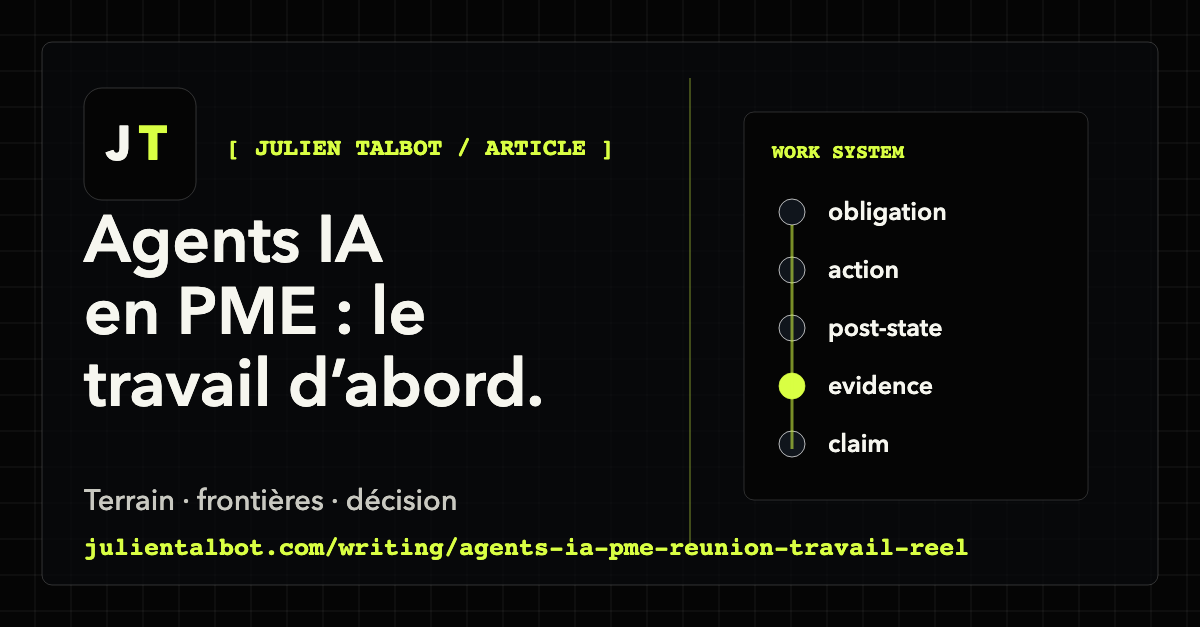
When an SME looks at AI agents, the promise is easy to see: automate tasks, answer faster, prepare documents, track requests, sort information, reduce part of the administrative load.
The promise is real. It becomes fragile when the starting point is the agent instead of the work.
An AI agent never enters an empty task. It enters an activity that is already organized, with habits, tools, responsibilities, exceptions, deadlines, customers, shared files, passwords, tradeoffs, and sometimes tensions.
So the right question is not: “Which agent can we install?”
The right question is: “Which work situation can be improved without losing evidence, control, and the ability to recover?”
What to frame before the agent
Before connecting an agent to business tools, a few simple points need to be clear:
- the precise task the agent should help with;
- what information the agent is allowed to read;
- what action it can propose;
- what action it must never perform alone;
- who validates;
- what trace remains available;
- how autonomy is reduced or stopped if the output drifts;
- how a person takes back control when an exception appears.
This is not abstract caution. It is work design.
An agent that saves ten minutes but creates twenty minutes of checking, explanation, or repair has not automated the work. It has moved it.
Reasonable first use cases
In Réunion as elsewhere, the strongest first use cases are often modest:
- preparing a summary of customer requests before human validation;
- sorting documents into a file with decision evidence;
- producing a first meeting note from a recording;
- spotting incomplete requests in an inbox;
- drafting a standard reply without sending it automatically;
- helping a business owner track follow-ups and priorities.
These cases look less spectacular than a fully autonomous agent. They are often better. They limit permissions, keep the human in the loop, and create useful evidence.
The role of ergonomics
Ergonomics brings a way of looking at AI that purely technical deployments often miss: observing what the tool does to real activity.
Who saves time? Who verifies? Who corrects? Who carries responsibility? Where does mental load move? What happens when the agent invents, oversimplifies, or hits an exception?
These questions matter for an SME because resources are limited and side effects show up fast.
See Situated AI and situated agents.
The simple rule
If the activity does not hold without the agent, the agent may amplify the disorder.
If the activity is understood, limited, traceable, and recoverable by competent humans, the agent can become real leverage.
Real work first. Autonomy second.